
The Ultimate Guide to Ecommerce Customer Segmentation
9. Conversio’s 3-step process to mastering customer segmentation
Contents
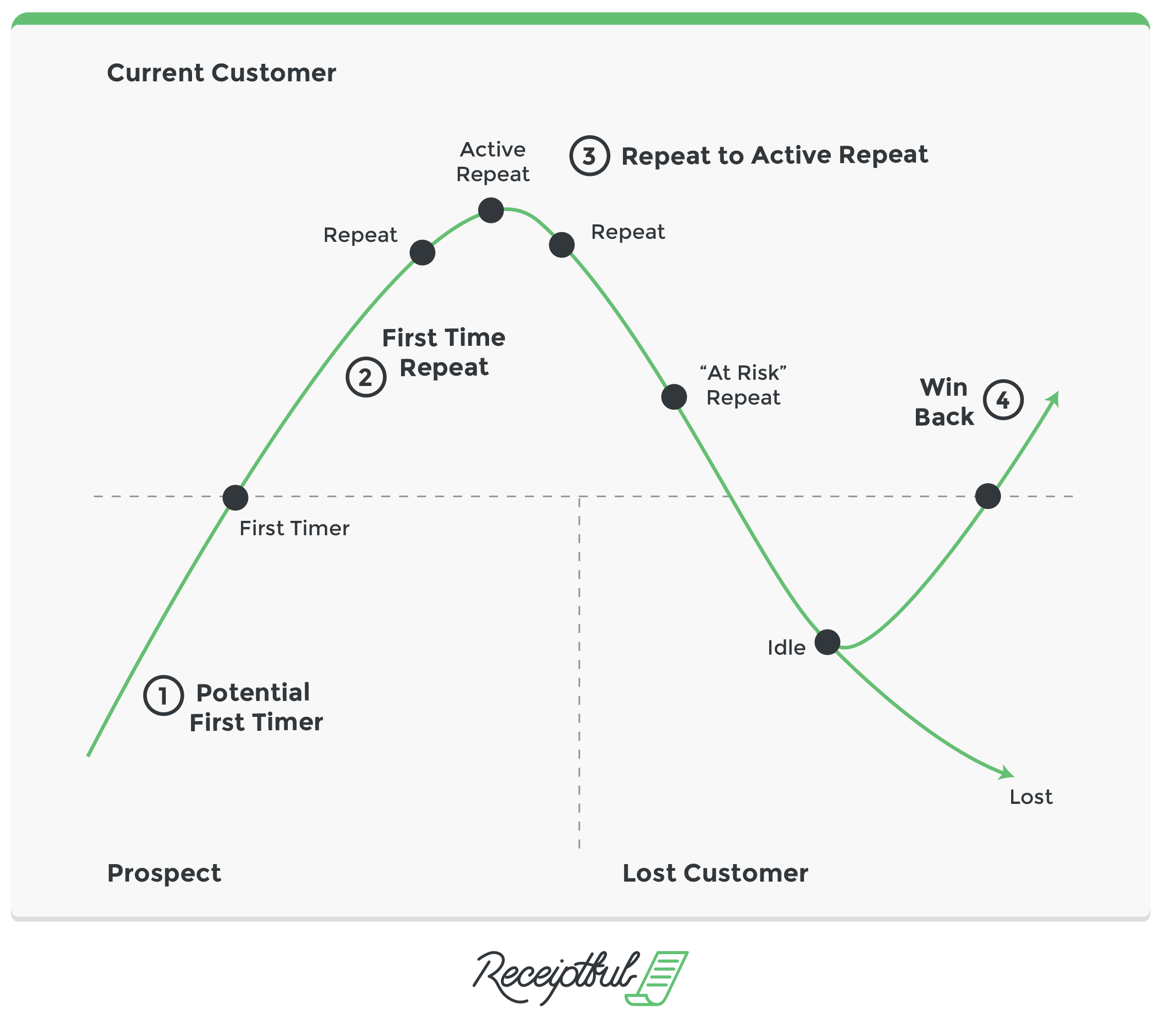
Before you dive deep into customer segmentation, it may be helpful to visualize the standard customer lifecycle or journey. The above chart shows how a prospect converts into a first-time buyer, then becomes a repeat customer, gets flagged as an “at-risk client,” then becomes an idle customer which store owners can either win-back or lose forever.
To harness the power of customer segmentation, you need to find opportunities to influence different consumer groups, weigh the potential impact of marketing to specific segments and execute on a pre-determined strategy.
1. Set clear goals per customer segment and identify potential growth opportunities based on value gaps
With each distinct customer segment comes a unique set of opportunities to increase those consumers’ average lifetime value. What store owners must do first though is list a specific goal they hope to achieve with each customer segment.
Using the customer lifecycle as a segmentation framework, we believe that the five primary goals stores owners can focus on are:
- Move Potential Customers to First-Time Buyers
- Move First-Time Buyers to Repeat
- Keep Repeat Customers active (in other words, move Repeat Customers to Active Repeat Customers)
- Move At-Risk Customers back to Repeat
- Win-back Idle Customers
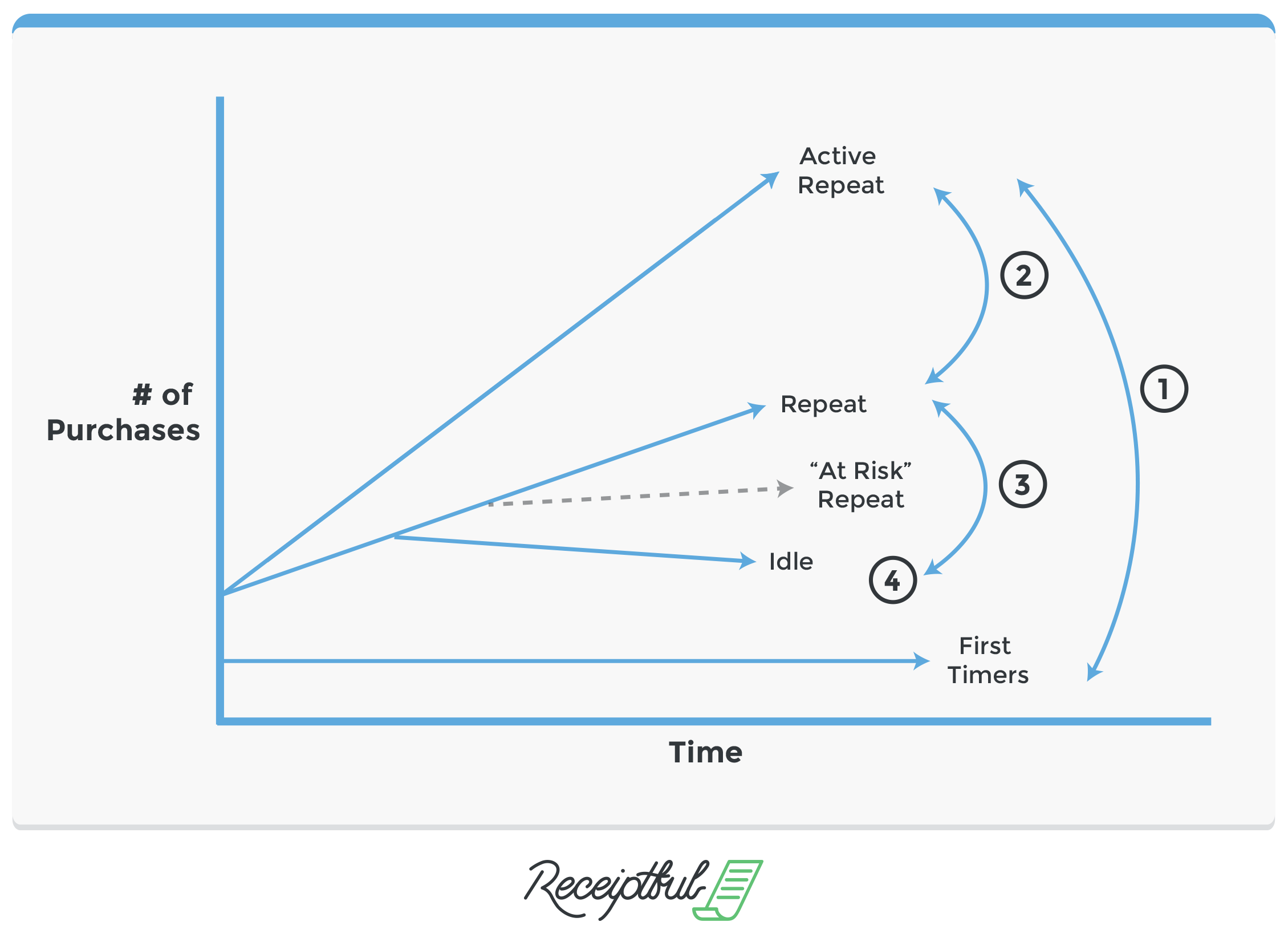
After declaring your goals, store owners should conduct a gap analysis, which Udemy’s Kasia Mikoluk defines as: “[The comparison of] the gap between an organization’s actual performance against its potential performance.” At this point it will be clear where your biggest growth opportunities exist. Below, we’ve illustrated how this may look.
2. Estimate the additional value generated from marketing to specific segments
After deciding the broader goals you hope to accomplish in marketing to specific customer segments, your next step should be to quantify what you stand to gain from each initiative. The goal here is to determine your priorities and estimate the size of the opportunity. With limited resources, such as cash, effort and time, store owners have to be strategic in their approach. Very few, if any, Ecommerce businesses are in the position to go full throttle on all these opportunities.
To clarify how this works, we have developed a template which you can use for your own business. And here we have included one way this may look:
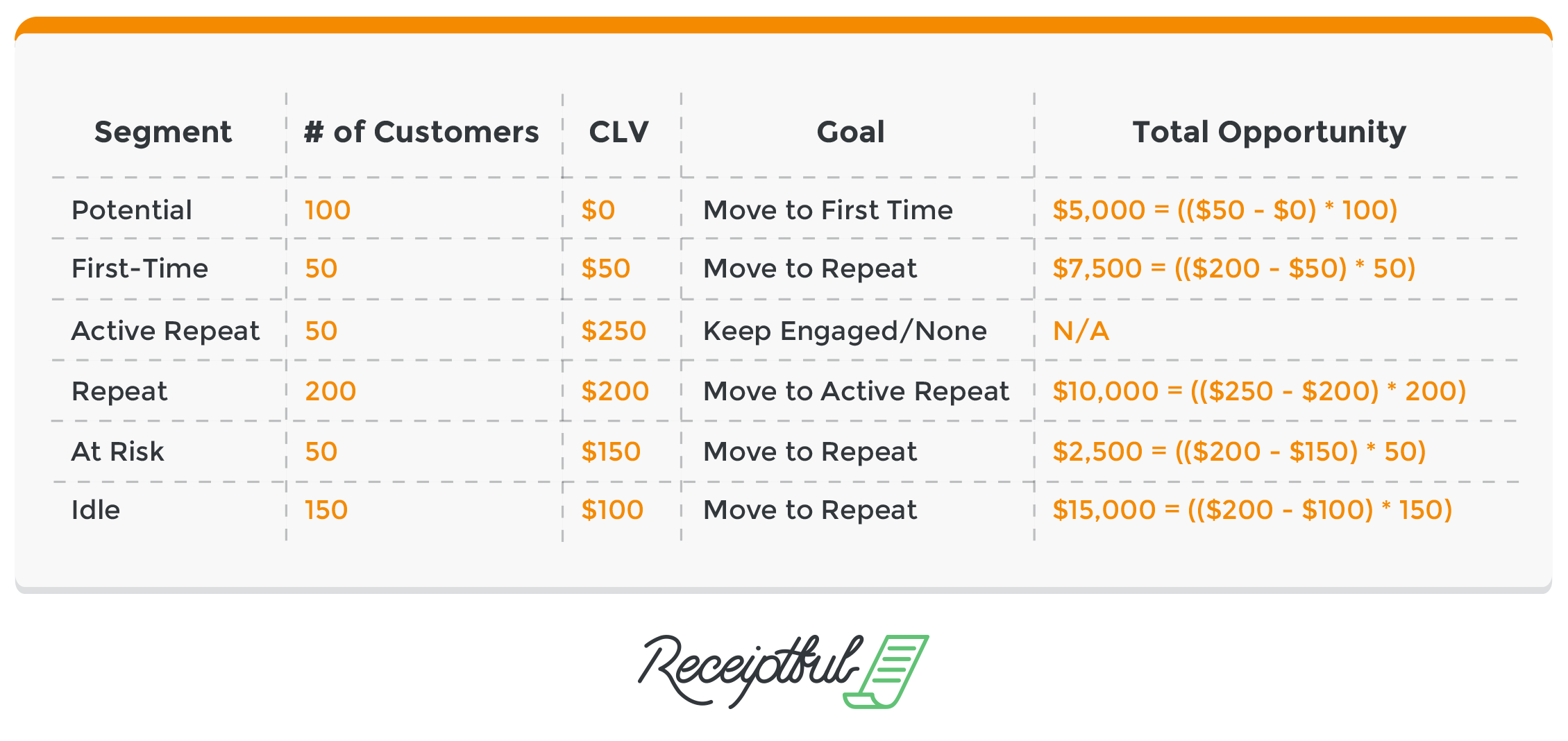
In the first column, we list the six individual stages of the customer lifecycle, which we are also using to distinguish customer segments. In the second column, we quantify the number of customers in each group. The third column shows the customer lifetime value (CLV) of an average customer in that particular segment. The fourth column states your expected outcome in marketing to that specific customer segment. The final column calculates how much additional revenue you can generate if you successfully accomplish your pre-determined goal for all your customers in that segment.
We define “Total Opportunity” as a function of ((goal segment CLV – current segment CLV) * # of customers). Specifically:
- Take the goal / target segment’s CLV.
- Deduct the current segment’s CLV which results in the potential opportunity.
- Multiply by the # of customers that you could move (assuming you could move all) to determine the total opportunity.
In the above illustration we find that idle customers present the biggest revenue growth opportunity. However, this is not an absolute truth for all businesses. Plug your own figures into columns 2 & 3 to see where you might be able to generate the most additional value.
Check it out!
We’ve put together a free spreadsheet so that you can see how this works using your own figures.
Open Doc
For the most part, your segmentation marketing priorities will be dependent on two factors:
- The number of customers in each segment.
- The difference in customer lifetime value (CLV) between “current” and “goal” segments.
Of course, one harder-to-quantify consideration can be how easy or difficult it may be to accomplish your set-out goal for each particular segment. Using the earlier example, that would mean moving customers from one lifecycle stage to another. Naturally though, convincing idle customers to return and become repeat customers once again may prove be a more resource-intensive project than simply engaging regular repeat customers and turning them into active repeat buyers.
3. Implement tactics to address each opportunity
CM Commerce’s 2016 customer segmentation survey revealed that only 37% of store owners segment their customer lists; 63% do not. Among those that do use actively differentiate between customers, 25% stated that they always customize their content for each distinct buyer segment while 66% said they sometimes do this and 9% say they never do this. As we have mentioned throughout this guide, store owners have largely neglected customer segmentation. And although you may have read all of our advice so far, here is where we challenge you to fully execute a segmentation marketing campaign.
Several concrete tactics for each segmentation goal include:
- Move Potential Customers to First-Time Buyers
- Welcome email series
- Abandoned cart campaign
- Drip email campaign
- Retargeting ads across display networks and on social media
- Move First-Time Buyers to Repeat
- Welcome email series
- Post-purchase email series
- Targeted digital receipt offers
- Regular email newsletters with promotional campaigns (and discounts)
- Direct mail catalogs, coupons or free product samples
- Keep Repeat Customers active (in other words, move Repeat Customers to Active Repeat Customers)
- Post-purchase email series
- Email newsletter with exclusive content
- Order replenishment/repurchasing reminders<
- Direct mail catalogs, coupons or free product samples
- Free expedited shipping offers
- Targeted pop-up shops in areas with high concentration of repeat customers
- Move At-Risk Customers back to Repeat
- Anniversary emails
- “We miss you” prompts
- Time-sensitive coupons
- Retargeting ads across display networks and on social media
- Win-back Idle Customers
- Win-back campaign
- Anniversary emails
- “How can we help?” questionnaires
- Big company announcements
- Retargeting ads across display networks and on social media
- Direct mail catalogs, coupons or free product samples
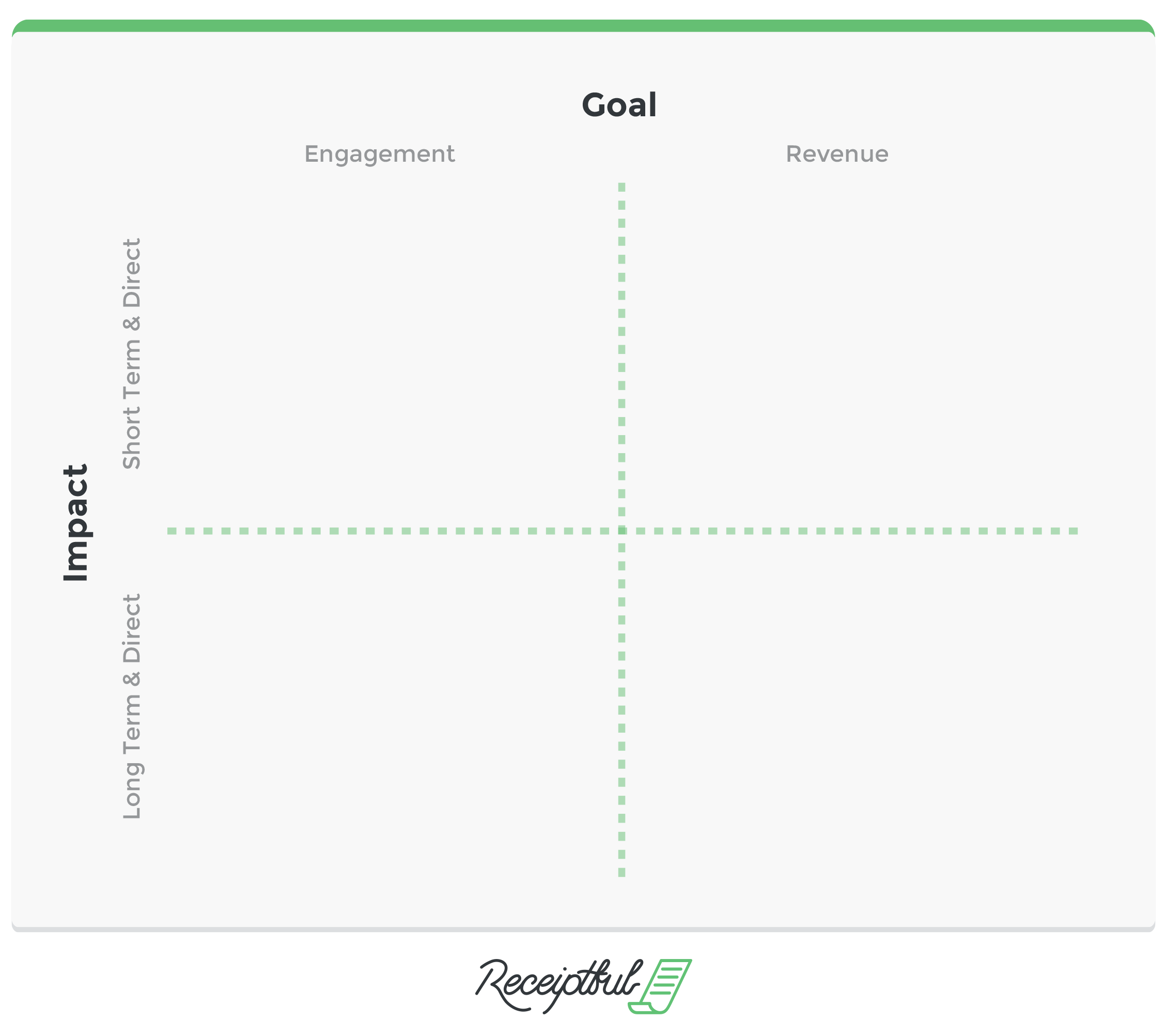
A helpful way to organize each segmentation opportunity is by utilizing the above 2-by-2 matrix. For every tactic, it is crucial that you consider its primary goal (revenue generation or customer engagement) as well as its expected timeframe (short or long) and impact (direct or indirect). Some segmentation approaches might be a combination of all of these too. Generally, you may want to prioritize any things that fall into the upper-right quadrant to drive direct revenue quickly.