
The Re-Engagement Recipe to Regain Customers and Revenue
Past-purchasers should be viewed as the low-hanging fruit of your marketing goals. You’ve already invested in this customer group. And you’ve already done a few things to make each of them feel special and valued.
There are a lot of logistical reasons why repeat customers are the most lucrative for your business.
Because they’ve already bought from you once, you have access to purchase preferences and buying habit data. You have direct access to them, either via email or mobile phone number.
Taken together, this means you can customize promotional offers to this target audience based on that past data.
If you’re not using email marketing to reach out to them—to customize offers for them based on past purchase behavior and buying data—you’re leaving revenue on the table.
The re-engagement recipe that’s ready in minutes
To save you time and energy—not to mention headaches—we provide a premade workflow that’s waiting for you in CM Commerce.
Once you sign up, all you have to do is go to Workflows and activate the Win-back series. As easy as that is, you should know why we designed the series the way we did so you can adapt it to serve your brand’s needs.
The purpose of this series is to re-engage those inactive customers and incentivize them to make another purchase.
We define an inactive customer as someone who hasn’t made another purchase in X days, where X is equal to three times the average days between orders of your best customers.
We recommend a three-message sequence to effectively re-engage inactive customers:
- Email #1: On the day that the customer becomes inactive, reach out and give the customer a small discount to make another purchase. Be as emotive as possible to urge the customer to come back.
- Email #2: Seven days after becoming inactive, use an alternative approach where you remind the customer of the discount you sent them the week prior and also show them some personalized product recommendations.
- Email #3: Fourteen days after becoming inactive: This is a last-ditch effort, where we increase the discount offer, but also limit the time frame (to 48 hours) to create a sense of urgency.
See how this breaks down in these examples from Project Nursery:


Re-engagement is as simple as turning a workflow on. Sign up for your free trial of CM Commerce and start ramping up repeat customers.
You can use the customer segments functionality to properly identify your inactive customers.
On top of that, the email sequence will stop if, for example, the customer makes a purchase before all of the emails were sent—so the first email (with a small discount) might be enough to entice the customer to come back.
The strategy behind our re-engagement series
After you’ve implemented the series and seen how it performs for your specific audience, you’ll want to make some changes. That’s the beauty of email marketing: You can constantly refine your strategy to see better and better numbers.
There’s truly no limit to what you can achieve when you keep testing and tweaking your process. But first you have to understand the logic behind the strategy.
Step 1: Identify customers who are candidates for re-engagement emails.
Will you target only those customers who bought from you within the past month? The past six months? The past year? You must start by defining “inactive” for your audience.
One important thing to know is that it makes sense to stay within a 12-month window of customers who have opened and clicked your email. There is typically a lower deliverability risk for email re-engagement campaigns using time frames of less than a year—meaning you’ll get fewer bounces because former customers have changed their email addresses.
Unlock customer recommendations and increase conversions with smart segmentation. It’s simple, easy, and effective with CM Commerce. Try it out today.
Step 2: Understand why customers don’t make a second purchase.
You will need to know the “why” of inactivity to devise the “how” of your re-engagement strategy.
It’s not always immediately obvious why customers have stopped doing business with you, which is why asking them for feedback is valuable.
When asking for feedback, you have the opportunity to win back business by making a compelling offer for filling out your survey. You also should look at the overall churn rate of your ecommerce business.
While some churn is both expected and acceptable, it’s important to discover the percentage of users who are turning over and to use that information as part of your re-engagement and retention strategies to build brand loyalty.
Step 3: Identify why your loyal customers remain active.
Your goals need to include specifics about how you plan to increase sales and the best way to do that is to understand the offers that encourage repeat business.
If you saw a specific sale or product from a past campaign that performed better than expected, bring it back. Did you have good luck with a certain upsell or recommendation strategy? Try it again.
When you add an incentive to bring past customers back into the fold, add a time limit to create a sense of urgency and prompt inactive customers to check out your deal.
Offer upgrades to a previously bought product. This approach is both personalized and highly valuable to individual subscribers. You can use the data on past purchase history to serve your customers personalized and targeted offers tied to their initial purchases.
Step 4: Clarify your purpose.
One of the most important tenets of successful email marketing—if not the most important—is to keep your communication transparent and honest. Inboxes are full of emails from ecommerce brands just like yours which means your subscribers will be familiar with any stunts you try to pull. Instead, just be honest.
Tell your customers you miss them and you want their business. Being straightforward with an accompanying discount proves you aren’t taking them for granted and you treat your customers with respect.
If you’re afraid you’ll lose too many customers that way, try inviting past customers to change their email preferences. Often, past purchasers will still want to receive your emails, but perhaps not as frequently. When that’s the case, you can encourage them to update their email preferences instead of going completely off your list.
Plus, you’ll be able to nurture them into making that next purchase when they’re ready.
Bonus tip: Reconnect with at-risk subscribers.
Another good idea is to keep your customers engaged before they lose interest in your brand. Instead of waiting for people to trigger a re-engagement campaign, create a segment based on at-risk factors so you can reach out before they need a last-ditch effort to bring them back.
One of the best ways to do this is to send them an anniversary email. And the good news for you? CM Commerce has a premade workflow for anniversary emails, too. Sign up and try it out here.
The anniversary email
Send customers an email on the anniversary of their first purchase and provide a discount to show your appreciation. If you provide a small period of time the offer is valid, you’ll create a sense of urgency to spur them into action.
The surprise factor of this email is sure to convince some of your customers to make another purchase.
In CM Commerce, use the delay from first purchase sending rule and send an email 365 days after their first purchase. Use the discount upsell element to include a unique discount coupon to celebrate with your customer on that day.
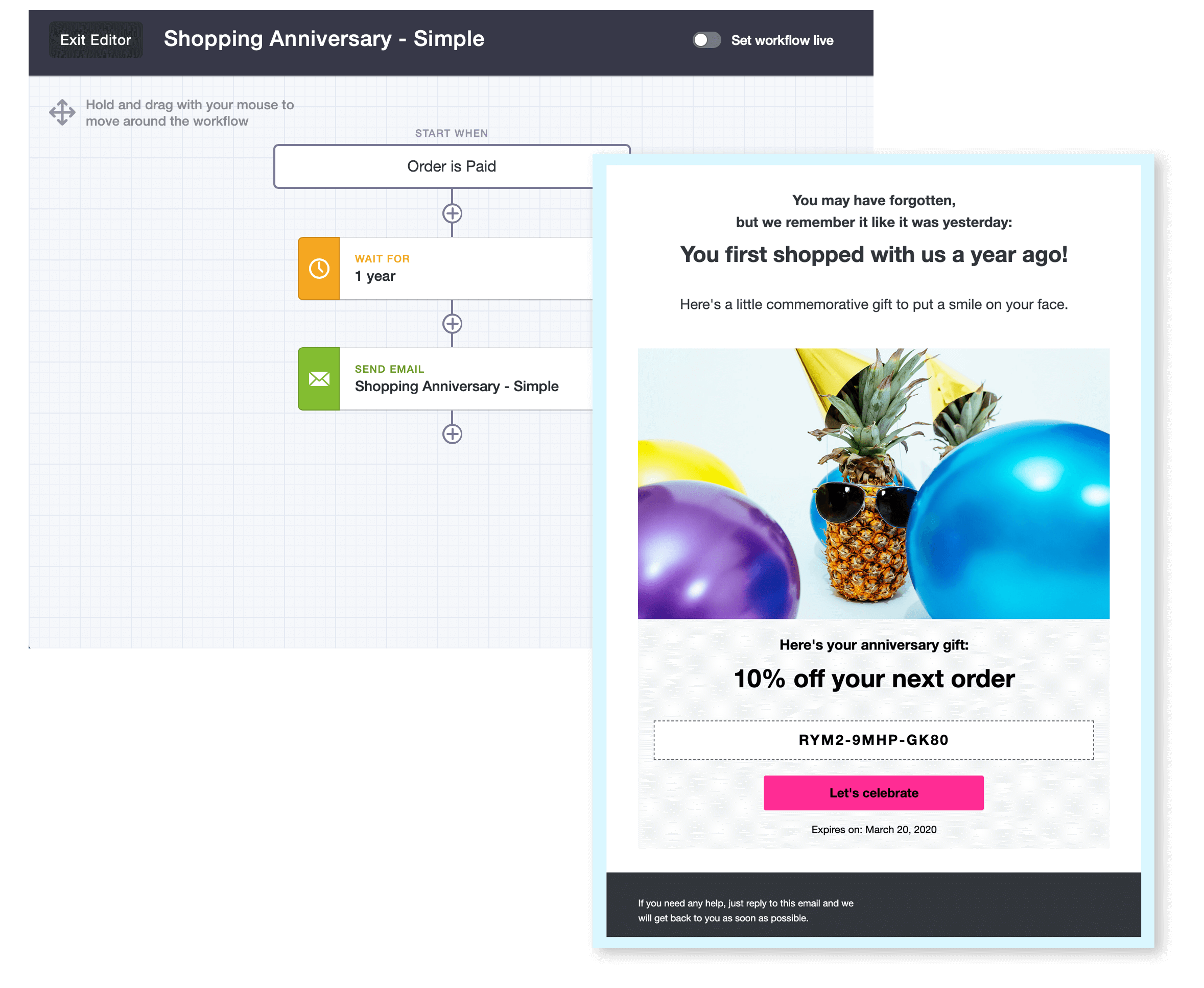
Or just turn on one of the premade workflows and you’re ready to go.
Wrap up
Some churn is natural and not a reason to worry. But these pre-built recipes make it simple to begin a re-engagement campaign that boosts your bottom line. In only minutes, you can provide world-class service and see an increase in revenue.
With nothing to lose and thousands of dollars to gain, get started today.