
Updated Newsletter Pricing: Simple Unlimited Sending
We first released Newsletters (as part of our rebranding from Receiptful to CM Commerce) in November 2017. At that time, we knew that we didn’t want to copy the way other bulk email sending services did their pricing. We also knew that it would take us some time to improve the way we did our own pricing. So we imagined a pricing model and started there.
Since then we’ve worked with many CM Commerce Premium customers, who have sent some awesome newsletters that have directly generated more than $600k in additional revenue.
Having sent more than 22 million newsletter emails and with some exciting new features coming to Newsletters in the coming weeks, we decided to update our newsletter pricing. This is what we’ve changed:
- There’s a new Newsletter Add-on option that is based on your average order volume (just like CM Commerce Premium right now). This Add-on importantly allows you to send as many newsletters as you want.
- A base CM Commerce Premium account does not have a free allocation of newsletters anymore. You will require the Add-on option to send newsletters.
- The Newsletter Add-on option will replace the previous “Additional Newsletters” plans we had for stores with higher sending volumes.
(Note: You can now see the changes in effect on our Pricing page.)
Where does this change come from?
While we have your attention, I’d like to explain why we use this pricing model at CM Commerce, especially because it is different to similar software solutions.
Our biggest motivation was to find a model where we could align ourselves very closely with our customers. We really wanted to double-down on the idea of “being in business together”. So the best metric we could find to tier our pricing plans was monthly order volume: If you sell more, we get paid more. If you have a down month, you pay us less too. (This model isn’t perfect in all scenarios. More on that later in this post.)
The most prevalent alternative within the email marketing or marketing automation space is to use the number of subscribers / customers / contacts as the way to tier pricing plans. This means that the more subscribers / customers / contacts you acquire, the more expensive your software bill becomes.
We just didn’t feel that this was the most efficient or fairest way to price CM Commerce, because it becomes quite expensive relatively quickly without necessarily having the same effect on the business performance.
Let’s look at an example
For this example, let’s look at a new store and their performance for 12 months. Some facts about the new store:
- Every month they process 250 orders.
- 30% of their orders every month (except for the first month) are repeat orders from existing customers.
If we put this into a table, this is what the data would look like:
| Repeat Customers? | 30% | |||||||||||
| Month | 1 | 2 | 3 | 4 | 5 | 6 | 7 | 8 | 9 | 10 | 11 | 12 |
| Monthly Orders | 250 | 250 | 250 | 250 | 250 | 250 | 250 | 250 | 250 | 250 | 250 | 250 |
| Total Customers | 250 | 425 | 600 | 775 | 950 | 1125 | 1300 | 1475 | 1650 | 1825 | 2000 | 2175 |
Now let’s visualise this on a graph:
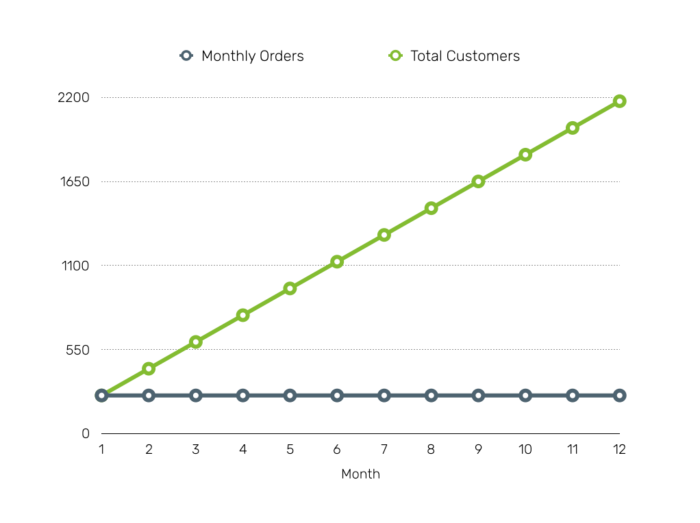
The difference in these are startling… With the pricing tiers based on monthly orders, the monthly software fee for this store thus stays the same. If she was however using software that tiered according to total customers, that price would be rising steadily.
That rise would have been easier to accept if it also led to more monthly orders. For this to happen though, the efficiency at which the store can use the software should stay constant throughout.
What we all know though is that a customer acquired in month 1 is harder to re-engage in month 3 and even harder in month 12. So this efficiency goes down over time.
If we take the same data table from above, we can calculate this “repeat efficiency”:
| Repeat Customers? | 30% | |||||||||||
| Month | 1 | 2 | 3 | 4 | 5 | 6 | 7 | 8 | 9 | 10 | 11 | 12 |
| Monthly Orders | 250 | 250 | 250 | 250 | 250 | 250 | 250 | 250 | 250 | 250 | 250 | 250 |
| Total Customers | 250 | 425 | 600 | 775 | 950 | 1125 | 1300 | 1475 | 1650 | 1825 | 2000 | 2175 |
| Repeat Efficiency | 0% | 17.65% | 12.50% | 9.68% | 7.89% | 6.67% | 5.77% | 5.08% | 4.55% | 4.11% | 3.75% | 3.45% |
And this is what that graph looks like:
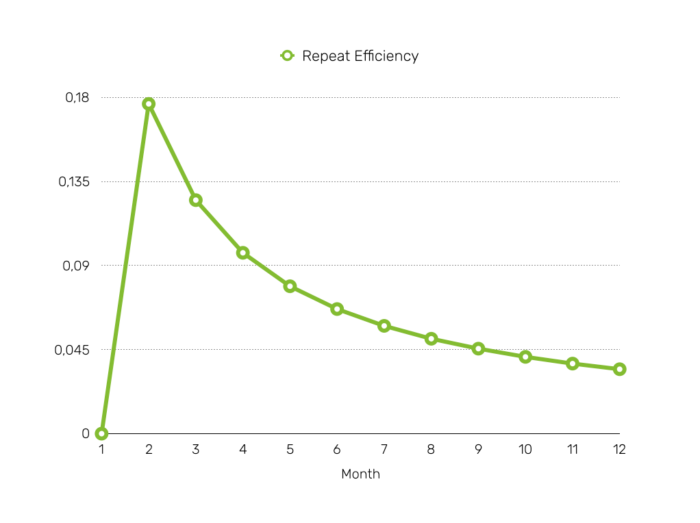
This graph trends in completely the opposite direction to the earlier graph where the total number of customers kept going up. This likely means that the store owner is paying more every month (as they acquire more subscribers / customers / contacts), but the direct value from the software loses efficiency gradually.
The truth in this situation is likely that it is not the fault of the software that this happens; it’s probably just human nature to become less engaged with a company or brand over time.
Regardless though, we wanted to fully align with the businesses that use our software, which is why we have directly tied our own business growth to that of our customers.
We’re not perfect
We’re by no means perfect and – as I mentioned earlier – our pricing model is by no means perfect either. There are two prevalent scenarios in which this model is challenging and not ideal:
- When a business has low gross profit margins; or
- When a business runs a temporary promotion at greatly discounted gross margins (which then increases their order volume significantly without increasing profit in the same ratio).
Beyond these, we will also regularly see that customers who activate all (or most) of their CM Commerce Premium tools will have a better return on their monthly software spend. We’re an all-in-one marketing dashboard, so our pricing also considers that most of our customers will use most of their available tools.
Regardless of these imperfections, we truly believe in the opportunity that we have today: we want to align ourselves with our customers for the long-term. We’re passionate about helping these businesses grow in the long-term. Even though there are many short-term tactics that we can implement to increase our own growth (like doubling our prices, which is a very popular mantra in the software world), we are more focused on wholesome, holistic and long-term thinking.
We’re in business together.
And if you haven’t joined our tribe yet, we’d love to have you.
(Header image by Mathyas Kurmann.)